
From AI-assisted literature reviews and analyses of past HTA decisions to global value dossier development and the identification of relevant analogues, the number of Market Access use cases continues to grow.
Companies are increasingly investing in applications designed to make Market Access work faster and more efficiently. This matters because the environment is changing quickly: the number and complexity of launches are rising, while Market Access resources remain stable or are declining. Yet AI remains underused because teams struggle to make it part of their daily work.
AI solutions are often launched with enthusiasm after a successful pilot with a small group of users and are presented as transformational. But a few months later, teams have returned to their previous ways of working, and use has not spread beyond the initial group. What happened? Why did adoption not take off?
A good tool is not automatically an adopted tool
A common assumption in technology projects is that if a solution works and saves time, users will naturally embrace it. In reality, AI transformation is rarely that simple and there are much more human aspects at stake.
Market Access teams may recognize that a tool can accelerate value dossier preparation, structure payer insights, or identify evidence gaps. Yet human behavior can still stand in the way of adoption. Does the tool genuinely make the work easier? Is it reliable? How can users be confident that the information and recommendations are sound? Would it be quicker to use the old approach? Last but not least, what’s in it for me ? This resistance can be legitimate, especially in life sciences and market access, where accuracy, consistency, and confidentiality matter. The following real-world examples illustrate poor AI adoption:
- Disappointing results from a Global Value Dossier solution: A global pharmaceutical company launched a Global Value Dossier solution to replace the traditional approach of outsourcing the work to vendors and reduce the time and budget needed for dossier localization. However, the solution was not mature enough, and the substantial changes required to the Value Dossier process at both global and local levels had been underestimated. As a result, adoption remained limited.
- Lack of interest in a Systematic Literature Review tool: A company invested significant time and money in developing an SLR tool intended to make evidence and data points easier to access. Use remained low, however, because the tool did not address a genuine pain point for the Market Access team.
- Limited adoption of a generic AI assistant: A company launched a secure, general-purpose AI assistant and expected the Market Access team to use it widely for everyday deliverables, such as developing payer value stories. Adoption remained limited, however, because users did not trust the tool and underestimated the work required to refine and improve its outputs.
Where does poor AI adoption in Market Access come from?
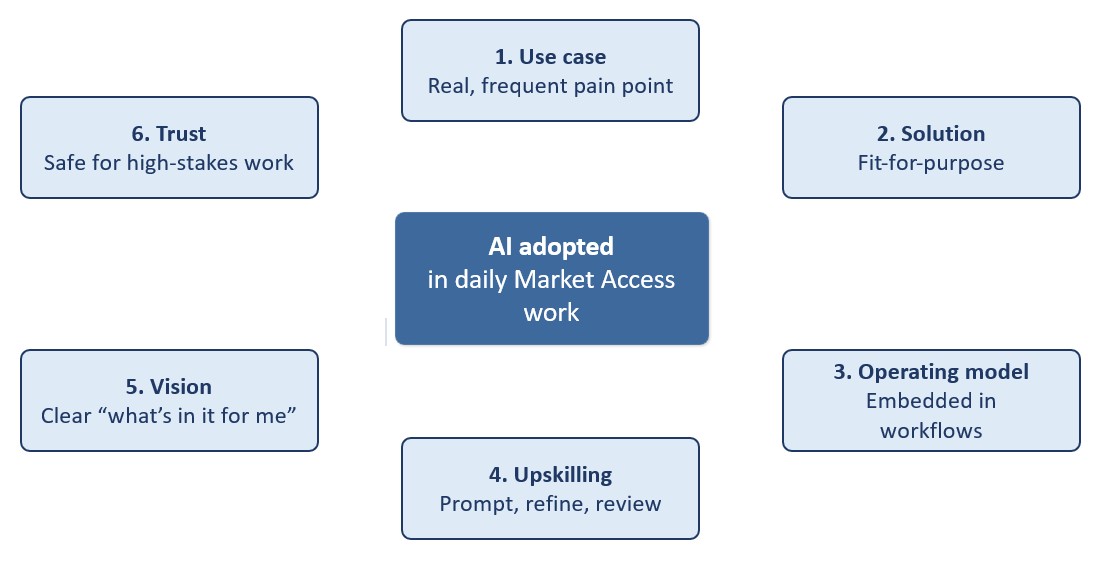
Change is inherently disruptive, which is why it often triggers resistance. In our work with clients, we consistently see six factors that need careful attention if AI is to be adopted successfully.
- Use case: Does the solution address a real, frequent, and important need or pain point? Have we prioritized the most important pain points? There are many potential use cases in Market Access, but organizations do not all face the same challenges.
- Solution: Are we selecting the right solution to encourage adoption? Technology evolves quickly, and the perception that a newly deployed tool is already obsolete can significantly discourage use.
- Operating model and processes: Is the solution compatible with current processes and workflows? If not, what must change, and how will that change be implemented? This is particularly challenging when both global and affiliate teams are involved or when the workflow is cross-functional.
- Upskilling: Do teams understand how to work with AI solutions, including large language models (LLMs)? They need to learn how to provide the right context, refine their requests, and review AI outputs critically.
- Vision: Does everyone in Market Access clearly understand what the transformation means for them? More directly: what’s in it for me? If AI saves time, how will that time be used for more valuable, strategic, and engaging work? Will my job still exist?
- Trust: How can teams ensure that AI does not put the quality of their work or the reputation of Market Access professionals at risk? Teams may hesitate to use AI for high-stakes or highly regulated work because of concerns about reliability, quality, and relevance.
How to implement successful change management for AI in Market Access?
Once the right use case, solution, and operating model are in place, a few emails, training sessions, and a launch presentation will not be enough to drive adoption.
Successful adoption requires effective change management: a structured process for preparing, enabling, and reinforcing the behavioral, organizational, and operational changes needed to generate value from a new solution. In these sensitive moments the “Change Network” should act as a key lever to help embark impacted populations and spread the “change story”.
At Elevio Group, we structure change management for AI adoption in Market Access around seven key steps and success factors.
- Diagnose: Involve Market Access end users in co-designing the initial assessment. When they help identify the pain points, they are more likely to adopt the solution (example pain point: local teams may not use a Global Value Dossier and may redo the work entirely).
- Define and celebrate success: Link AI to Market Access objectives and priorities. AI should help achieve clear business goals (for example, giving Market Access a greater role in early-stage asset development).
- Anticipate barriers: Identify potential barriers to adoption and engage skeptical stakeholders early (for example, if people fear that AI will threaten Market Access jobs, acknowledge and address that concern).
- Communicate: Keep teams informed and engaged through project newsletters, success stories, and shared best practices. Start communicating early, decide what to communicate, when, and through which channels.
- Upskill: Identify the skills teams need to use AI solutions effectively (for example, how to identify and manage hallucinations, and how to write prompts suited to Market Access activities), and beyond (hard and soft skills).
- Foster: Put mechanisms and incentives in place to encourage AI adoption (for example, considering appropriate AI use in annual performance evaluations).
- Pilot: Monitor progress and adoption to ensure that the change takes hold. Use meaningful measures of success; for example, individual token consumption may not be the right metric for adoption or value in Market Access.
So, when is an AI transformation project truly complete?
Be ready for the journey. AI transformation is unlikely to end here. The future of the Market Access function is still being defined, but one thing is certain: you need to prepare your Market Access team for that future, starting now. And you need to do it well, effective change management is essential.
About Elevio Group
Elevio Group supports pharmaceutical companies with AI and Market Access transformation, global Market Access strategy, and value maximization throughout drug development. Contact us to learn more about our AI transformation experience and how we can help prepare your Market Access team for what comes next.