
Market Access teams are increasingly moving beyond experimentation with LLMs and asking a more practical question: how can AI become useful in recurring day-to-day work without requiring every user to become an expert in prompting, or every use case to justify the development of a new software application? One emerging answer is the use of reusable, task-specific AI modules, referred to as AI “Skills”: predefined ways of guiding AI through a specific Market Access task, such as developing a preliminary Market Access assessment or structuring a payer value story. By embedding an agreed methodology, relevant sources, analytical rules, and quality controls, Skills can provide more guidance and consistency than a general-purpose LLM alone, while remaining lighter and more flexible than bespoke software. They should therefore be seen not as a replacement for either approach, but as a complementary option that broadens the ways in which AI can support Market Access teams.
The limitations of current AI approaches for Market Access
The use of LLMs in Market Access has developed rapidly, but the way organizations translate the technology into practical capabilities is still evolving. Over the past few years, many pharmaceutical companies have experimented with internal copilots, automated literature reviews, insight platforms, evidence tools and other dedicated applications, often with promising results at pilot stage. The challenge has generally appeared later, when these solutions need to be maintained, integrated into existing processes and, most importantly, used consistently by teams whose primary role is not to operate AI tools.
This experience is gradually exposing a limitation in the way AI deployment has often been approached. For a relatively narrow Market Access need, building a dedicated application may require a disproportionate amount of technical development, interface design, validation, training and maintenance. At the other extreme, providing teams with access to a general-purpose large language model offers considerable flexibility, but leaves much of the methodology to the individual user, who still needs to know how to formulate the task, identify the appropriate sources, structure the analysis and assess whether the output is reliable. AI Skills offer an interesting alternative between these two models.
Turning Market Access expertise into reusable AI modules
An AI Skill is, in essence, a structured way of teaching an AI system how to perform a defined piece of work. Rather than simply providing a prompt, the Skill can incorporate the sequence of analytical steps to follow, the sources that should be prioritized, methodological principles, calculation rules, quality controls, reference materials and the expected structure of the output. The objective is not to remove expert judgment, but to ensure that the AI starts from an established way of working rather than reconstructing the approach each time a user asks a question.
Consider, for example, an economic burden assessment for an early-stage asset. A well-designed Skill could define how incidence and prevalence should be researched, which direct and indirect cost components should be considered, how evidence should be treated when country-specific data are unavailable, and how assumptions and data gaps should be documented. The same principle could be applied to treatment-landscape reviews, HTA precedent analyses, price benchmarking, payer archetyping, evidence-gap assessments or early Market Access opportunity evaluations.
What makes this approach particularly relevant for Market Access is that a substantial part of the function's work already relies on repeatable analytical approaches, even when the strategic conclusions remain highly specific to each asset. Organizations have accumulated methodologies, templates, source lists, decision rules and experience over many years, but much of this knowledge continues to sit in presentations, project folders or, quite simply, in the heads of experienced team members. Converting selected parts of that knowledge into Skills creates the possibility of making it available more systematically, while retaining the flexibility required for complex strategic work.
A more modular model for Market Access AI
The opportunity becomes more significant when Skills are considered not as isolated automations, but as components that can be combined. A Market Access BD assessment, for instance, might require an epidemiology analysis, a review of the current treatment landscape, an assessment of relevant HTA precedents, identification of pricing analogues and, finally, a synthesis of these elements into an initial view of the opportunity and its key uncertainties. Rather than developing one large application covering the entire process, these activities could be supported by several specialized Skills that are reused independently in other analyses.
This modularity addresses some of the practical difficulties that have slowed AI adoption. Individual Skills can be developed around clearly defined needs, tested with the experts who currently perform the work, updated as methodologies or sources change, and progressively assembled into broader workflows. From the user's perspective, much of this complexity can remain in the background, reducing the need to understand the technical architecture or master sophisticated prompting techniques.
There are, of course, important questions around governance, source quality, validation and the appropriate role of human review, particularly for analyses that will inform strategic or investment decisions. Skills do not make those requirements disappear. What they may do, however, is provide a more manageable unit around which standards and controls can be designed, rather than attempting to govern either completely open-ended use of generative AI or increasingly complex bespoke applications.
Combining the right AI approaches for Market Access
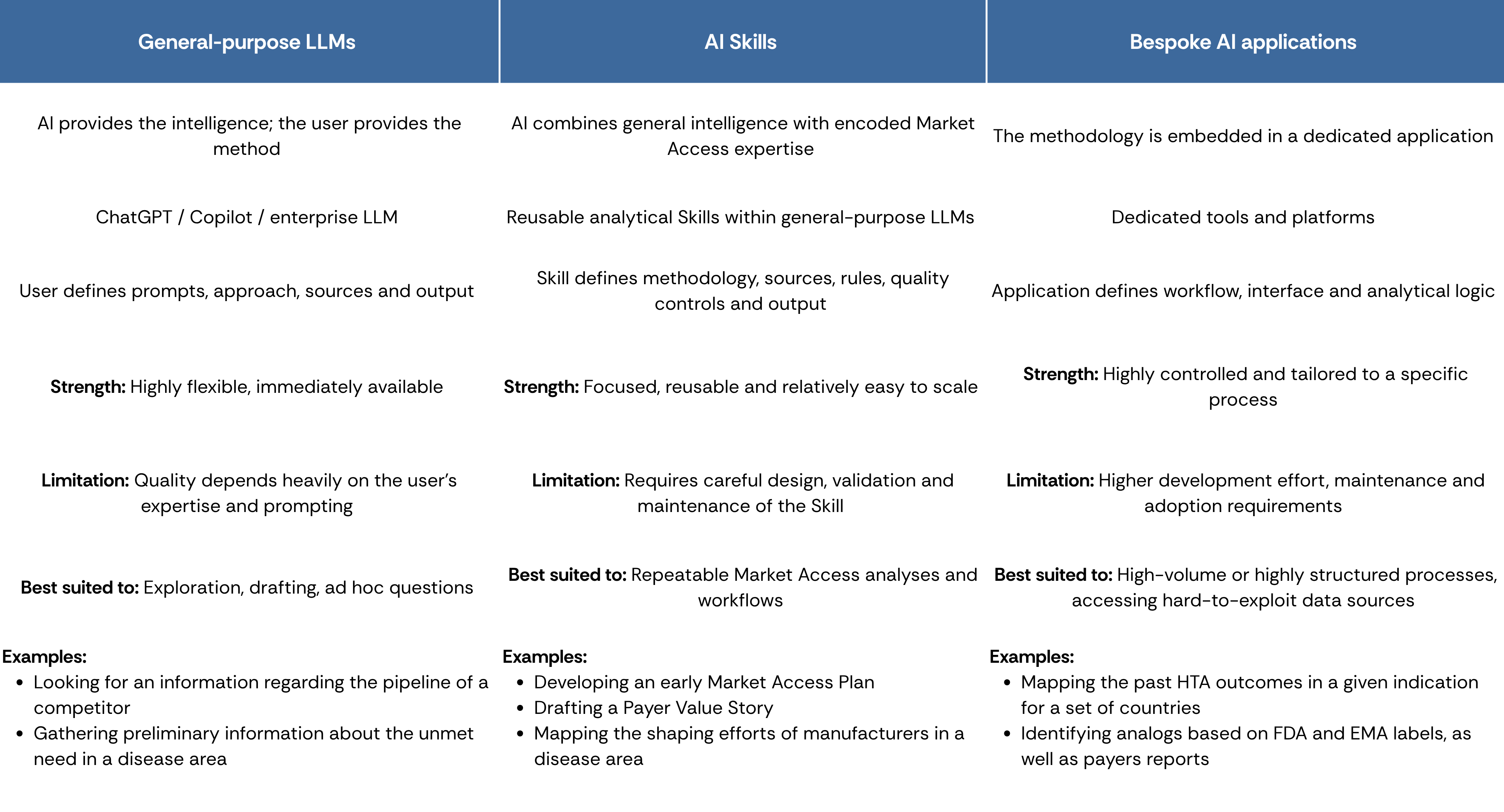
The emergence of Skills does not mean that Market Access organizations should move away from general-purpose LLMs or bespoke AI applications. Each approach serves a different purpose. General-purpose LLMs remain particularly valuable for exploration, drafting and ad hoc questions, where flexibility matters most. Bespoke applications are better suited to highly structured processes, complex integrations or situations where large and difficult-to-access datasets need to be systematically analyzed. Skills sit between these two approaches, bringing more structure and embedded Market Access expertise to repeatable tasks without requiring a dedicated application to be developed for each one.
The most effective AI model for Market Access is therefore likely to combine all three. The real opportunity is not to select one technology over another, but to determine which level of structure, specialization and investment is appropriate for each activity. In this model, Skills become an additional building block that can extend the usefulness of the general-purpose AI tools already available to teams, while bespoke solutions continue to address the use cases that genuinely require them.
For Market Access leaders, this creates a broader and potentially more pragmatic AI roadmap: not a succession of new applications, but a portfolio combining general-purpose AI, reusable Skills and dedicated solutions according to the nature of the work to be done.
Contact us if you want to know more about how we help Market Access teams develop their set of reusable Skills!
About Elevio Group
Elevio Group is a global Market Access strategy consultancy supporting pharmaceutical companies throughout drug development and commercialization. We combine deep Market Access expertise, strategic consulting, technology, and AI-enabled innovation to help clients strengthen evidence strategies, optimize market access, and maximize the value of their assets.